/
/
Batwara 1947 Twitter Review: Sunny Deol, Shabana Azmi and Preity Zinta win praise, but mixed reactions question the film’s slow pace and old-school drama.
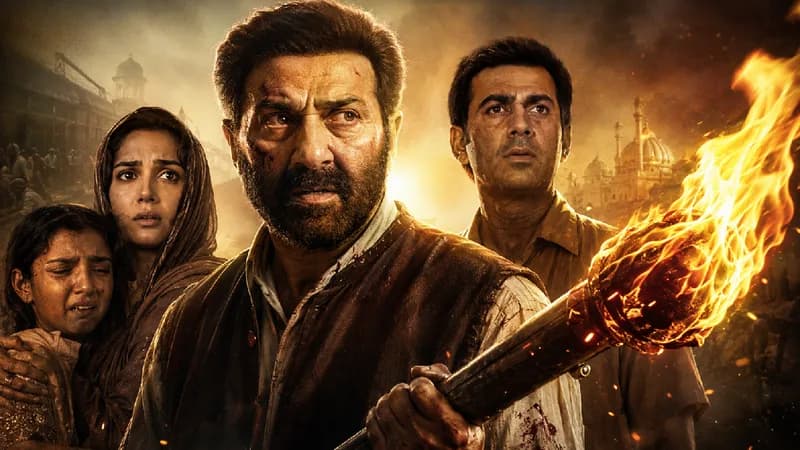
Sunny Deol is back in the conversation, and this time it's for something that clearly means a great deal to him. The Batwara 1947 Twitter Review responses have been coming in thick and fast since Rajkumar Santoshi's Partition drama hit theatres on August 14, just a day before Independence Day, and what viewers are saying is genuinely split down the middle. Performances are drawing real emotion. The story is being called meaningful. But not everyone is walking out fully satisfied.
Starring Sunny Deol, Preity Zinta, Shabana Azmi, Karan Deol and Ali Fazal, and produced by Aamir Khan Productions, the film is set against the chaos and grief of Partition. At its heart is a Muslim family that arrives in Lahore and finds an elderly Hindu woman still living in the house that has been allotted to them.
If the early noise on X is anything to go by, Sunny Deol Batwara 1947 is very much his film to carry, and he is carrying it.
Viewers have been praising him not just for the intensity and commanding dialogue delivery people have always associated with him, but for something quieter too, vulnerability, fear, and a kind of raw emotional pain that many say his eyes convey better than any line of dialogue could.
Some fans have drawn comparisons to his earlier work in films like Ghayal, Damini and Ghatak, while others have simply called the film a powerful cinematic experience and celebrated his reunion with Santoshi.
Film critic Taran Adarsh was among those who praised Deol's restraint, vulnerability and authority, calling him outstanding and highlighting the film's emotional second half and its message about humanity rising above hatred.
That said, not every reaction has been glowing. Some viewers feel that his familiar loud confrontations and action-heavy moments occasionally pull focus away from the quieter, more intimate Partition story the film is trying to tell.
Shabana Azmi Batwara 1947 might not be grabbing the headlines that Deol is, but she is making a lasting impression on those who have seen the film.
She plays Mai, an elderly Hindu woman who flatly refuses to leave her Lahore home after Partition. What begins as a standoff over a house slowly becomes something far more human, as her relationship with Sikandar Mirza and his family shifts from tension to something resembling family.
Several early reactions have called Mai one of the most memorable characters in the film. One particularly enthusiastic viewer described her as stubborn, warm and emotionally compelling. Others pointed to her bond with Sunny Deol as the film's true emotional centre.
Critics have also noted that Azmi brings a quiet dignity to the role, something that could easily have become symbolic or heavy-handed in less capable hands.
The film follows Sikandar Mirza, played by Sunny Deol, as he leaves India with his family during Partition and eventually reaches Lahore. There, the family is allotted a house, only to find that Mai is still inside it, unwilling to go, holding on to a home and a hope connected to a missing family member.
What starts as conflict gradually becomes connection. The house stops being just a property and starts becoming something much larger, a metaphor for two communities trying to survive the fear, displacement and hatred that Partition left in its wake.
The film draws inspiration from Asghar Wajahat's acclaimed play Jis Lahore Nai Vekhya, O Jamya E Nai, which centres on a remarkably similar story. The play has reportedly faced restrictions in Pakistan.
This is where things get more complicated, and where the Batwara 1947 review conversation really starts to fracture.
People who love the film talk about its emotional writing, its unconventional premise and its willingness to put human stories above political noise. Many have called it a worthy Independence Day watch precisely because it focuses on ordinary people trapped inside extraordinary circumstances.
But critics keep coming back to the same word: pacing.
The first half is felt to be slow by a good number of viewers, taking longer than necessary to establish itself. Certain stretches in the second half are described as drawn out. And beyond pacing, there is criticism of what some are calling an old-school dramatic style, loud dialogue, exaggerated antagonists, action sequences that feel out of place in a film that is otherwise trying to say something delicate.
So the film finds itself in an interesting position. Its story resonates. Its message lands for many people. But the way it is told is dividing the room.
Preity Zinta's return to cinema has been one of the film's quieter but genuine talking points. Early reactions have appreciated her presence and her emotional performance, with some viewers describing her role as one of the more dramatically substantial parts in the film.
Karan Deol has received a more mixed response. Some viewers have been pleasantly surprised by his performance and appreciated his character's arc, while critics have noted that he occasionally struggles with the emotional range his scenes demand.
Ali Fazal has been picked out for bringing a restrained, quieter energy to the film, a contrast that several viewers seem to have found refreshing.
The film arrives at the same time as Emraan Hashmi's Awarapan 2, making this one of the more anticipated Bollywood clashes of the Independence Day weekend. Advance-booking figures had placed Awarapan 2 ahead going into release, which means Batwara 1947 faces a real commercial challenge despite the presence of Deol and a strong ensemble.
Its August 14 release date does give it the benefit of the Independence Day holiday on the 15th, and much of what happens at the box office from here will depend on whether the divided early buzz can turn into genuine word of mouth.
The early Batwara 1947 X review picture is best described as mixed but emotionally charged, which, in a way, feels fitting for a film about one of history's most emotionally charged events.
Sunny Deol is winning real praise. Shabana Azmi's Mai has become a talking point all of her own. And the film's central idea, that humanity can outlast religious division, even in the darkest of times, has clearly connected with a meaningful portion of the audience.
But the criticism is real too. Slow pacing, overly long dramatic passages, predictable villains and an old-fashioned presentation style have left some viewers underwhelmed.
For Sunny Deol fans and anyone drawn to Partition dramas, there is enough emotion and performance here to make a theatrical viewing worthwhile. For viewers expecting a tightly constructed modern historical film, the mixed reactions are probably telling you something honest.
The film has been certified A by the CBFC without cuts and released in theatres on August 14, 2026.