/
/
Meenakshi Natarajan’s Rajya Sabha nomination was rejected in MP, triggering a major political storm as Congress alleges seat theft.
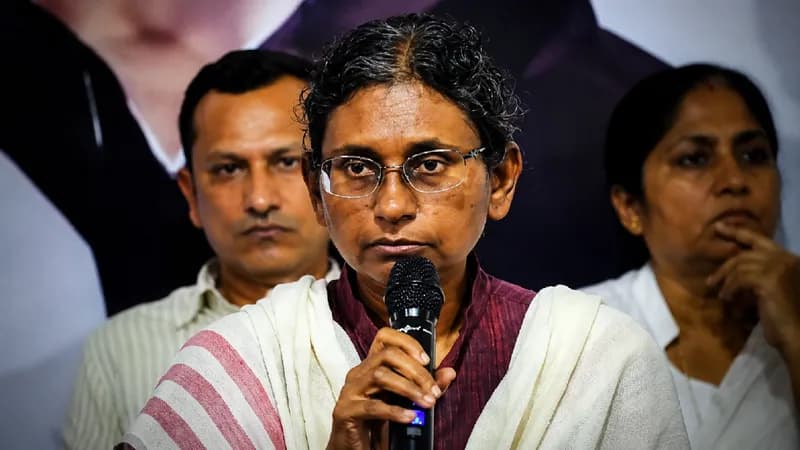
In a dramatic development ahead of the Madhya Pradesh Rajya Sabha election, Meenakshi Natarajan nomination rejected has become the biggest political story in the state. The Congress candidate's nomination was cancelled during scrutiny after objections were raised over an allegedly undisclosed court matter linked to Telangana.
The fallout has been immediate and fierce. What was already a tightly contested election has now turned into an all-out political war between Congress and BJP, with accusations of procedural violations on one side and outright "seat theft" on the other.
The controversy started when BJP leaders raised objections to Natarajan's nomination papers during scrutiny.
According to the Returning Officer, Natarajan did not disclose details of a pending private complaint before a court in Hyderabad while filing Form 26, the affidavit that candidates are required to submit during the nomination process.
After examining the documents and hearing arguments from both sides, the Returning Officer rejected her nomination, stating that the affidavit was incomplete and that material information had not been disclosed.
The decision immediately changed the dynamics of the June 18 Rajya Sabha election in Madhya Pradesh.
Congress has strongly opposed the rejection and described it as an attack on democracy.
Party leaders argue that there is no registered criminal case or FIR against Meenakshi Natarajan. According to the Congress legal team, the Hyderabad matter is merely a private complaint in which the court had issued a notice, and no criminal proceedings have formally begun.
Congress leaders claim that such a notice does not legally require disclosure in the election affidavit. They have accused BJP of using technical objections to secure a third Rajya Sabha seat despite lacking the required numbers in the Assembly.
The party has announced that it will challenge the decision before the Election Commission and may also approach the courts.
BJP has completely rejected Congress' allegations.
The party argues that once a court has issued a notice or summons and the candidate is aware of the matter, it becomes relevant information that should be disclosed in the affidavit.
Madhya Pradesh Chief Minister Mohan Yadav didn't stop there. He suggested experienced politicians simply don't forget details like this by accident, and Congress should be looking inward rather than pointing fingers at BJP.
Senior BJP leader Kailash Vijayvargiya also claimed that documents related to the Telangana case were supplied by individuals connected to Congress itself.
The entire dispute revolves around one crucial question:
Was Meenakshi Natarajan legally required to disclose the Hyderabad court matter in her nomination affidavit?
Congress says no. Their lawyers argue the case is still at a preliminary stage, the court has not taken formal cognizance of any criminal offence, and it therefore can't be treated as a criminal case requiring disclosure.
BJP says yes, any pending court proceeding the candidate is aware of should have been mentioned in the affidavit, FIR or not.
This legal interpretation will likely become the central issue if the matter reaches higher judicial forums.
The stakes were already high in the MP Rajya Sabha Election.
In the 230-member Madhya Pradesh Assembly, BJP has 164 MLAs. The party was comfortably positioned to win two Rajya Sabha seats, while the third seat was expected to witness a contest.
Congress had become so concerned about possible cross-voting that it planned to move its MLAs to Bengaluru. However, before that strategy could play out, the nomination rejection completely changed the picture.
With Meenakshi Natarajan out of the race, BJP's three candidates are now in a much stronger position, and the possibility of all three winning has increased significantly unless Congress secures immediate legal relief.
The fallout has extended beyond legal arguments.
Congress leaders staged protests in Bhopal and Delhi, accusing authorities of acting under political pressure. Workers organised demonstrations, while senior leaders, including MPs and former chief ministers, demanded the Election Commission step in.
For Congress, this has become bigger than one candidate's nomination. They're framing it as a fight for democratic process itself.
The next moves will play out before election authorities, and very possibly before a court.
If Congress manages to overturn the Returning Officer's decision, the Rajya Sabha contest snaps back to being competitive. If not, BJP may walk away with all three seats from Madhya Pradesh without a real contest.
Either way, the rejection of Meenakshi Natarajan's nomination has turned a high-stakes election into one of the most closely watched political controversies of 2026.
Both parties are digging in, and at this point, the outcome may have less to do with political muscle and more to do with how election law reads a single line in an affidavit.