

/
/
Anthropic CEO Dario Amodei reveals why he left OpenAI, citing AI scaling beliefs and safety concerns that eventually led to Anthropic's creation.
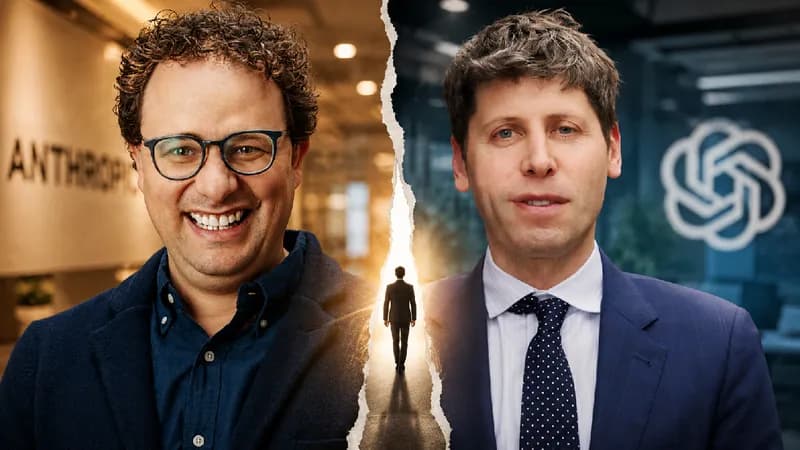
A major chapter in the AI industry's rivalry has become clearer. Discussions about Dario Amodei OpenAI are back in the headlines after Anthropic CEO Dario Amodei explained why he left the company he helped build and went on to start a competing AI firm.
Speaking on entrepreneur Nikhil Kamath's podcast WTF Is, Amodei said two core beliefs drove his decision: a conviction in the power of AI scaling and a deep concern for AI safety. Those convictions ultimately led him to leave OpenAI and co-found Anthropic, now one of its strongest competitors.
Amodei joined OpenAI soon after it was founded in 2015 and rose to become head of research. He played a central role in early large language model work, contributing to research that paved the way for GPT-2 and GPT-3.
By 2019, he and several colleagues had begun to see AI’s path differently. One major disagreement involved what are now called "scaling laws", the idea that AI systems become far more capable with more compute, larger models, and more data.
At the time, many people inside and outside the field didn’t accept that idea. "There were a lot of folks inside and outside who didn't believe it at all," Amodei recalled from the early GPT-2 era. Today’s AI successes largely validate that approach, but Amodei says he and his colleagues were arguing for it years before it became the consensus.
While scaling was an important debate, Amodei says AI safety became the decisive issue. He warned that if AI reached human-level reasoning, the societal consequences could be enormous, reshaping economies, national security, politics, and daily life.
Because of that, he believed developing AI demanded a deep, serious commitment to safety. Amodei said he wasn’t convinced OpenAI’s approach matched the responsibility required for such powerful technology. Although OpenAI often talked about responsible development, he remained doubtful about how deeply that commitment was embedded in the organization.
Rather than keep debating the company’s direction, his conclusion was straightforward: build something new.
In 2021, Amodei, his sister Daniela Amodei, and several former OpenAI researchers launched Anthropic. The company was founded around many of the principles Amodei felt were essential, particularly a strong focus on safety and responsible deployment.
Since then, Anthropic has grown into one of the most influential AI firms. Its Claude family of models competes directly with OpenAI’s ChatGPT in both consumer and enterprise markets. The startup has also received backing from big companies like Amazon and Google, which has helped it grow into one of the main competitors in the rapidly expanding AI industry.
What makes the OpenAI-Anthropic story notable is that the rivalry didn’t start from wholly different ideas. It started with a group of coworkers who ended up disagreeing on how AI should be built and managed.
The competition between Sam Altman and Dario Amodei perfectly shows the massive debate happening in tech right now, how fast should we push AI forward versus how much should we focus on safety and oversight?
Even with their differences, both leaders recently backed an open letter calling for stronger protections against AI-assisted biological threats, showing they can still work together when the risks are too serious to ignore.
Amodei’s remarks come as the AI industry accelerates. Companies are pouring billions into larger, more capable models while regulators and governments wrestle with control measures.
His comments offer a rare look at internal disagreements that helped shape today’s AI landscape. They’re also a reminder that many influential AI companies were founded by people who once shared offices, research goals, and a vision of the future. Now they’re pursuing that future in different ways, and the result could shape the next decade of technology.










