Purnia Family Performs Symbolic Funeral for Daughter After Inter-Caste Court Marriage
A Purnia family performed symbolic last rites for 18-year-old Riya after she married her Dalit boyfriend, triggering debate over caste and family pressure.


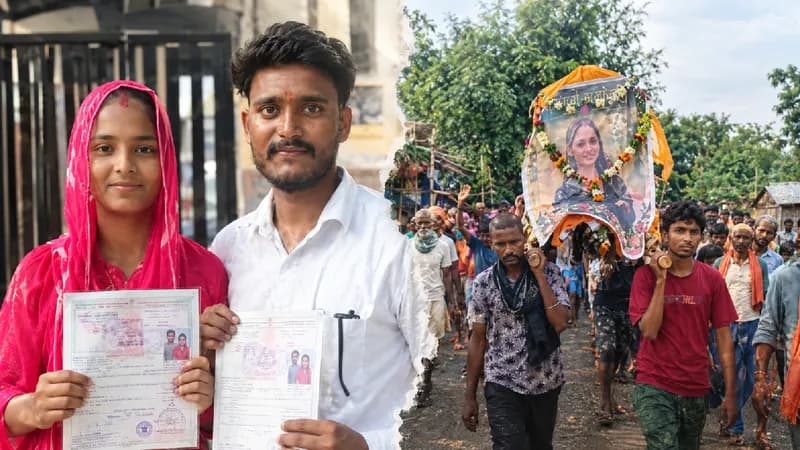
There are family disputes, and then there are moments that make you stop and wonder how far apart two generations can truly be. What happened in Chapay village in Purnia, Bihar, falls firmly into the second category. An 18-year-old woman married the man she loved, and her family responded by holding a funeral for her, with an effigy in her place.
The Purnia family symbolic funeral has since triggered a much larger conversation about caste, love, and what it means for a family to truly accept an adult child's choices.
The woman has been identified in reports as Riya Goswami. Her husband is identified as Milan Kumar, also referred to as Milan Paswan, a 24-year-old man from a Scheduled Caste community. The two had reportedly been in a relationship for around three years before things came to a head.
Riya Goswami and Milan Kumar's Court Marriage
According to reports, Riya left her home on September 8 and married Milan in court. When her father, Manoj Kumar Goswami, realised she was gone, he filed a missing complaint with the police, fearing she had been taken against her will.
Police eventually traced Riya to Delhi and brought her before a court. There, she reportedly said clearly that the Riya Goswami Milan Kumar marriage had been entirely her own decision, and that she wanted to stay with her husband.
That statement, it seems, was the turning point, not toward acceptance, but toward something far more extreme.
Family Takes Out Symbolic Funeral Procession
Rather than coming to terms with her decision, the family chose a very public way of cutting ties. The Purnia family symbolic funeral involved an effigy carrying Riya's photograph, placed on a bier and carried through the village in a procession that mirrored the rituals of an actual funeral.
Riya's father reportedly performed symbolic cremation rituals, and the family declared that she was, in their words, "dead" to them. Reports also mention that the family planned to carry out additional death-related rituals, including shraddha and pind-daan.
To be clear, Riya was not physically present as a deceased person. This was entirely a symbolic ceremony. But the message it was meant to send was unmistakable.
Family Had Already Fixed Her Marriage for November
Adding another layer to the controversy, Riya's father reportedly said the family had already arranged her marriage with a government teacher from Bhagalpur, with the wedding set for November. Preparations for that marriage had apparently already begun before Riya left home.
Some reports have mentioned a figure of ₹6 lakh in connection with the proposed match, though reports are not consistent on what exactly that amount referred to, so that detail deserves some caution before drawing conclusions.
Community Meeting Failed to Separate the Couple
Before things escalated, there was reportedly an attempt to resolve the situation through a community meeting. Villagers brought both sides together and tried to persuade the couple to separate. It didn't work. The two held firm, and shortly after, Riya left home and married Milan.
The Purnia inter-caste marriage case then moved beyond a private family matter into something the wider community became involved in, and has since become a flashpoint for debate about caste expectations and personal freedom.
Why the Purnia Case Has Sparked Debate
Opposition to a marriage is, unfortunately, not uncommon in many parts of India. But what set this case apart was the step the family chose to take: symbolic last rites, a procession through the village, and rituals typically reserved for the dead, all to signal that their relationship with their daughter was over.
It's worth noting that most of what we know about this case comes from statements made by the family, villagers, and news reports. Riya's own perspective, beyond her statement to the court, has not been widely reported. That context matters.
What does remain clear is this: Riya told a court she had married Milan of her own free will. And her family, unable or unwilling to accept that, chose to symbolically treat her as though she no longer existed, all because she had chosen a partner from a different caste.
Disclaimer: This report is based on information published by multiple news outlets. Some details remain based on statements attributed to family members or villagers and may be subject to further clarification.