

/
/
Shashi Tharoor urges Gen Z backing Cockroach Janta Party to seek change through democracy, RTI and political participation, not social media alone.
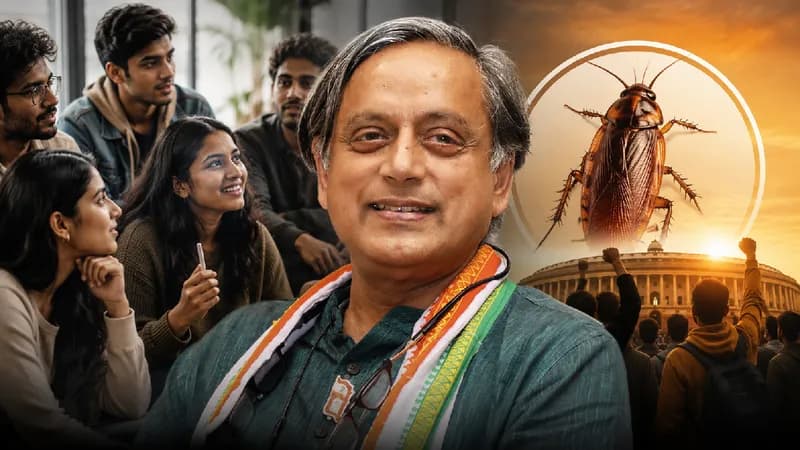
The explosive rise of the Cockroach Janta Party has caught the attention of India’s political class, and now Shashi Tharoor has stepped into the debate with a message aimed directly at Gen Z.
In a strongly worded column published on Thursday, the Congress MP acknowledged the anger, frustration and disappointment driving millions of young Indians toward the viral movement founded by Abhijeet Dipke. But he also warned that social media outrage alone cannot deliver lasting change.
“Instagram is your town square. But it is not a ballot box,” Tharoor wrote, urging young people to turn their frustration into organised democratic action.
Tharoor did not dismiss the concerns that have fueled the Cockroach Janta Party's rapid growth. Instead, he openly recognised the struggles many young Indians face today.
Referring to repeated examination controversies, including paper leak allegations and administrative failures, he said students who spend years preparing for competitive exams feel deeply betrayed when systems fail them.
According to Tharoor, stories emerging from examination centres and growing concerns over employment opportunities have created a sense of disillusionment among many young Indians.
He wrote that the pain and anger behind the movement are real and deserve to be heard.
It started as a satirical social media campaign, but soon grew into one of the biggest online movements people have seen in India in recent years.
Founded by Abhijeet Dipke, the Cockroach Janta Party took off after remarks attributed to a senior judicial figure sparked widespread outrage online. It struck a nerve, especially among young people fed up with unemployment, exam scandals and a system that seems to look through them rather than at them.
Within days, the campaign had attracted millions of followers and was everywhere online. Supporters saw it as a voice for their frustrations, while critics felt it showed how much trust between young people and institutions has broken down.
While expressing sympathy for the movement's supporters, Tharoor cautioned against treating online activism as a complete solution.
He described the Cockroach Janta Party as a powerful piece of political theatre that captures the feeling of being ignored by the system. However, he stressed that anger alone cannot create meaningful reform.
“History shows us that while rage can ignite a fire, it requires a steady hand and a clear strategy to build a structure that endures,” he argued.
His central message was simple: don't let the frustration stop at a post or a meme. Make it count.
The Congress leader laid out a handful of practical steps for Gen Z supporters who want to move beyond the screen.
Tharoor urged young citizens to go directly to their local MPs and MLAs, not just to vent, but to show up with structured grievances and expect answers. He also pointed to the Right to Information (RTI) Act as an underused tool for demanding transparency in exams, recruitment and public administration.
Broad dissatisfaction, he argued, doesn't move the needle. Concrete demands do. When movements come with clear policy proposals, both the media and lawmakers are pushed to talk about solutions rather than just scandals.
He encouraged supporters to link up with student organisations, legal groups and policy advocates, people who can help draft petitions, pursue legal remedies and keep sustained pressure on the right people.
"The most successful movements in democratic history didn't just shout; they organised, they drafted, they lobbied, they agitated," he wrote.
Tharoor also made the case for showing up in the everyday, unglamorous work of democracy, local governance, voter mobilisation, civic engagement. Viral moments are fleeting; sustained participation is what actually shifts things.
In the most widely shared part of his message, Tharoor urged supporters not to define themselves by anger or by the label adopted by the movement.
“You don’t need to be treated like cockroaches, and you don’t need to adopt the label as your permanent identity,” he wrote.
He called on young Indians to work with political leaders, institutions and democratic mechanisms to build a system that respects students, job-seekers and ordinary citizens.
The rapid growth of the Cockroach Janta Party reflects a deeper conversation unfolding across India. Behind the memes, slogans and viral posts lies a generation demanding accountability, opportunity and respect.
Tharoor’s intervention is significant because it does not reject that frustration. Instead, it attempts to redirect it.
Whether Gen Z embraces that advice remains to be seen. But as the movement continues to dominate social media and public discussion, one thing is clear: the concerns driving young Indians are no longer being ignored by mainstream politics.









