Madhya Pradesh Passenger Transport Vision Summit 2026: 15,000 Buses Planned by 2030
The two-day Passenger Transport Vision Summit 2026 was formally inaugurated at the Brilliant Convention Centre in Indore, with Madhya Pradesh Chief Minister Dr Mohan Yadav outlining the state's plans to build a modern, technology-driven and passenger-centric public transport system.


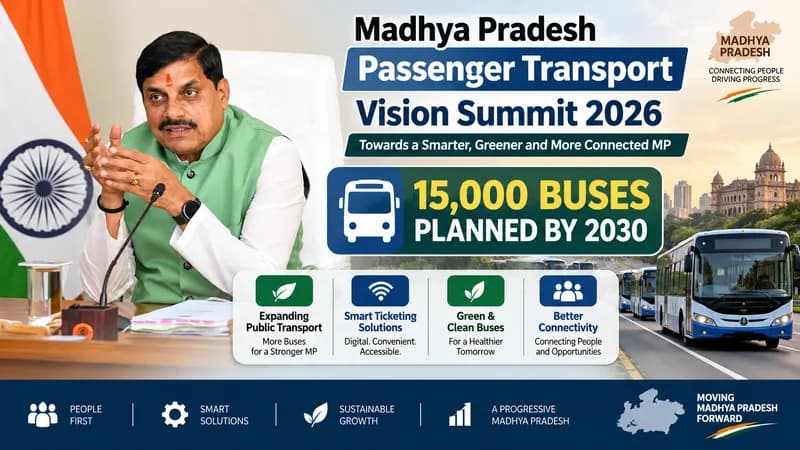
The two-day Passenger Transport Vision Summit 2026 was formally inaugurated at the Brilliant Convention Centre in Indore, with Madhya Pradesh Chief Minister Dr Mohan Yadav outlining the state's plans to build a modern, technology-driven and passenger-centric public transport system.
Addressing the summit, the Chief Minister said that after nearly two decades, the state government is preparing to introduce a new model in the public transport sector. The proposed system will use advanced technology to provide passengers with more convenient, faster and safer travel services.
The summit is bringing together government officials, transport experts, private operators and industry representatives to discuss the future of passenger mobility in Madhya Pradesh.
Public Transport Demand Rising Across Madhya Pradesh
Highlighting the growing demand for public transportation, CM Mohan Yadav pointed to Madhya Pradesh's extensive road network, which currently exceeds 5 lakh kilometres.
He also highlighted the rapid growth in religious tourism, particularly in Ujjain. According to the Chief Minister, annual pilgrim footfall in the city, which was earlier around 60–70 lakh, has in recent times crossed 8 crore.
The sharp increase in passenger movement has made the expansion and modernisation of public transport infrastructure increasingly important, he said.
15,000 New Buses Planned Under Sugam Parivahan Seva
One of the major announcements at the summit is the government's plan to introduce around 15,000 new buses across Madhya Pradesh by 2030 under the Mukhyamantri Sugam Parivahan Seva.
The government plans to involve private bus operators in the initiative and equip the transport network with modern technologies.
The proposed public-private model is intended to expand the availability of passenger services while improving operational efficiency and convenience for commuters.
New Transport Model to Be Rolled Out in September
The Chief Minister said that under the Seva Sankalp Month, being observed from September 17 to October 17, the first official offering under the new transport model will be presented to the people of Madhya Pradesh on September 25.
The initiative is being positioned as a new phase for public transportation in the state, with technology and modern buses expected to play a central role.
Electric, Hydrogen and Flex-Fuel Buses in Focus
Green mobility is another major component of the state's transport vision.
Madhya Pradesh is increasingly focusing on electric vehicles, and the government wants residents of the state to benefit from the expanding EV manufacturing ecosystem.
Following the development of the Indore Metro, the state is now looking at wider deployment of electric, hydrogen and flex-fuel buses.
The proposed transition is aimed at creating a cleaner and more sustainable public transport network while reducing dependence on conventional fuel-based vehicles.
Traditional Bus Design to Return With Modern Facilities
The new service will also feature buses in the traditional saffron colour, combined with modern passenger facilities.
The government has described the planned rollout as a fresh beginning for public transportation in Madhya Pradesh, combining familiar visual elements with upgraded technology and services.
The initiative is being launched around the celebrations marking Prime Minister Narendra Modi's birthday.
AI to Drive Madhya Pradesh Mobility Vision 2030
Artificial intelligence and modern information technology will form an important part of the state's Mobility Vision 2030.
The summit is discussing the use of AI-based route planning, digital ticketing and other technology-enabled solutions to improve public transport operations.
AI and passenger data can potentially help authorities identify travel demand, optimise routes and improve bus scheduling, particularly on busy intra-city and inter-city corridors.
PPP Model to Strengthen Public Transport
Public-private partnership is another key area being discussed at the summit.
The state government is looking at ways to encourage private investment in bus operations and Intelligent Transport Management Systems.
The proposed model aims to combine government oversight and infrastructure with private-sector expertise, technology and operational capabilities.
The broader goal is to create a public transport system that is not only convenient for passengers but also financially sustainable over the long term.
Eight Key Areas Under Mobility Vision 2030
The two-day summit is focusing on eight major areas related to the future of passenger transportation in Madhya Pradesh.
These include public-private partnerships, future passenger transport infrastructure, financially sustainable bus operations, employment and entrepreneurship, passenger safety and convenience, data-driven decision-making, green mobility and the “One State, One Journey” concept.
Integrated ticketing and technology-based transport management are also expected to be important elements of the state's future mobility framework.
Focus on Safer and More Sustainable Travel
The Passenger Transport Vision Summit 2026 signals a broader attempt by Madhya Pradesh to modernise its public transport network after years of limited expansion.
The proposed 15,000-bus target, greater participation from private operators, AI-based planning and the introduction of cleaner fuel technologies could significantly reshape bus transportation in the state if implemented as planned.
For passengers, the government's stated focus is on making travel more accessible, reliable, safe and convenient while moving the state's transport system towards a greener and technology-driven model.