Niu Lai: China’s ‘Worst’ Animated Film Turns Viral After Viewers Mock Its Rough Animation
Niu Lai went from a box-office flop to a viral Chinese hit after viewers mocked its rough animation. Here’s how the mother-son film became a sensation.


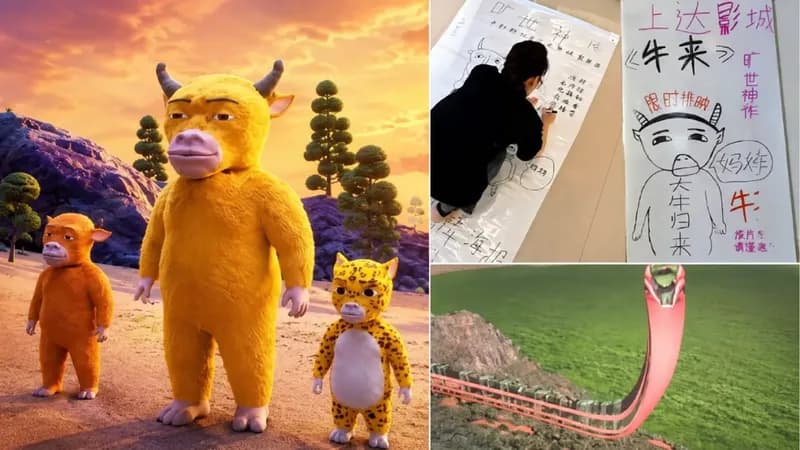
How did a movie that barely anyone watched suddenly become one of China’s biggest cinema talking points? Niu Lai has managed exactly that, and the strangest part is that people first came for the film because they thought its animation was terrible.
The Chinese animated film, released on August 5, initially looked destined to disappear. It reportedly earned only 342 yuan on its opening day and about 7,700 yuan during its first 10 days, with fewer than 300 tickets sold. But after clips of its stiff 3D characters, awkward movements and bizarre scenes spread online, curiosity took over.
By August 23, the film had crossed 45 million yuan (about $6.7 million) at the Chinese box office, according to Chinese box-office data cited by Global Times.
And yes, audiences really started buying tickets to see what all the fuss was about.
Niu Lai Box Office: From 342 Yuan to More Than 45 Million
The numbers tell the story better than almost anything else.
When Niu Lai opened on August 5, there was virtually no conventional marketing campaign behind it. There was no major promotional tour, no flashy trailer and reportedly not even enough official promotional material for cinemas.
The film's first 10 days brought in only around 7,700 yuan. Then, around August 14, clips and screenshots began spreading rapidly across Chinese social media.
People mocked the animation, the stiff character movements, unusual voice acting and strange visual choices. Some viewers compared the movie to an unfinished student project, while others joked that it looked so crude that even AI might struggle to reproduce it.
Instead of killing the movie, the criticism created a powerful curiosity gap.
People who had never heard of Niu Lai suddenly wanted to watch it, not necessarily because they expected a great film, but because they wanted to experience the movie everyone was laughing about.
That online curiosity translated directly into cinema tickets. AFP reported that the film rose from roughly 7,000 yuan in its opening week to 33.06 million yuan, according to Maoyan. Later reporting on August 23 put the total above 45 million yuan.
The rise was so dramatic that cinemas began adding screenings to meet demand.
Hi,guys.This is Niu Lai (牛来) with English subtitles.
— MAI (@justsoai) August 17, 2026
It is also worth noting that the film’s cover bears the line:“A cow can rehearse its life—in dreams…”
My English is pretty poor, and even with AI translation tools, it took me several hours to finish the subtitles. If… pic.twitter.com/Fa5C8Sj01L
What Is Niu Lai About?
Underneath all the memes, Niu Lai is actually a fairly simple and earnest story.
The film follows a young calf named Niu Lai, who struggles to stand and eventually enters a dreamlike adventure. He encounters other animals, including a bird, a leopard and wolves, while facing danger and separation from his mother.
The story explores familiar themes such as family, friendship, courage and sacrifice.
The irony is that audiences initially paid very little attention to the story. What caught the internet's eye was the filmmaking itself.
The 86-minute movie features low-detail 3D models, stiff movements, sparse environments and unconventional animation choices. Some scenes became memes precisely because they looked so unusual.
Yet once viewers discovered the story behind the production, their attitude began to change.
A newly released animated film called “Niu Lai” (牛来) is going viral for all the wrong reasons in China.
— Tong Bingxue 仝冰雪 (@tongbingxue) August 15, 2026
People are calling the visuals “disaster-level” , the entire production team was basically just two people: the director and the screenwriter. After 9 days in theaters, the… pic.twitter.com/l7RM9ZER67
A Mother and Son Spent Five Years Making It
This is arguably the most human part of the Niu Lai story.
The film was created primarily by director Xin Yumeng and his mother, Sun Lifang. Xin had no conventional professional background in animation or filmmaking. He worked on the project for around five years, learning the process while making the movie.
Xin reportedly relied on second-hand computer equipment and had to work around serious technical limitations. At one point, hardware problems made rendering complex scenes difficult, forcing him to rethink how sequences would be created.
His mother was far more than a supporting figure. Sun helped write the screenplay, worked on voices and administrative tasks, and also contributed music to the film. The pair created the movie without the kind of large production team normally associated with theatrical animation.
That backstory gave the film a completely different meaning for many viewers.
What initially looked like laziness or incompetence began to look, to some audiences, like evidence of an enormous personal effort.
网友翻唱电影《牛来》主题曲《雨后轻风有香》,意外冲上热搜。这首歌曲由牛来导演母亲孙丽芳女士亲自作词作曲并演唱,歌曲富有前苏联曲调风格。网友称该主题曲满怀一个普通家庭的妈妈对儿子事业的帮助与期待,听了竟深受感动。 pic.twitter.com/U3Gz8TbyFw
— 作家崔成浩 (@cuichenghao) August 17, 2026
Why the Bad Animation Became the Best Marketing
Normally, a movie going viral because viewers think it looks terrible would be a nightmare for its creators.
With Niu Lai, it became the opposite.
The film had almost no traditional marketing, but social media effectively became its advertising department. Every strange scene generated another joke. Every joke introduced the film to more people. And every new viewer potentially created another video or post.
Cinemas also became part of the phenomenon. Hand-drawn posters and banners featuring the cow appeared in some locations, creating another layer of internet content. Merchandise featuring the film's characters also began appearing online. AFP reported that sellers moved quickly to offer items such as keychains, shirts and figurines after the film became a meme.
This is where Niu Lai box office becomes particularly interesting.
The film didn't follow the usual path of movie marketing:
studio promotion → audience awareness → ticket sales
Instead, it effectively went:
bad reviews → memes → curiosity → audience demand → more screenings → bigger box office
Reuters described the phenomenon as a kind of internet-driven distribution, with audiences themselves helping push cinemas to show the film.
在《龙餐馆》和《奥德赛》等一众大片宣传海报当中,《牛来》的海报独具匠心。
— 曾颖 (@zengying1107) August 17, 2026
由于《牛来》没有宣发预算,没有制作海报,据说电影院门口的海报都是影院工作人员自己手搓的,这又怎么不是一场,全民狂欢的抽象接力呢。😅 pic.twitter.com/UULip6al3l
Is Niu Lai Really an “Anti-AI” Movie?
That's another reason the film has connected with audiences in 2026.
The animation looks dated and technically rough at a time when generative AI can produce increasingly polished images and videos within seconds.
Yet Niu Lai was reportedly made manually over years, without generative AI being used as the shortcut audiences might expect today. That contrast has led some viewers to celebrate the film as an example of human-made work, even when the final result is far from technically perfect.
One audience member interviewed by AFP described the film as “so bad that it's so good,” while noting that the effort behind it made the movie difficult to hate.
That sentiment is important.
People aren't suddenly pretending the animation is technically excellent. Most of the viral discussion still acknowledges its flaws. What has changed is the way those flaws are being interpreted.
The awkward movements are now part of the joke. The crude models have become recognizable. And the fact that a mother and son spent years creating the movie gives those imperfections an emotional context.
Not Everyone Thinks the Success Is a Good Thing
The story isn't universally positive.
Some critics and industry observers have questioned whether a movie's viral popularity should translate into such a major theatrical reward simply because audiences want to laugh at it.
A Beijing News editorial warned that excessive attention to poorly made films could lower expectations and undermine confidence in professional filmmaking, according to international reporting.
There is also a legitimate question about whether the Niu Lai phenomenon can ever be repeated.
Probably not.
Its success depends on a very specific combination: an unusually rough-looking film, an almost nonexistent marketing campaign, a bizarre viral moment, curiosity-driven audiences and a broader cultural conversation about authenticity and AI.
Trying to manufacture another “bad movie that becomes a hit” would probably destroy the very thing that made Niu Lai interesting.
The Internet Turned Niu Lai Into More Than a Movie
The film's popularity has now moved beyond cinemas.
Memes, fan-made posters, merchandise and parody content have spread across social platforms. Its imagery has even been picked up by organizations and brands outside the film industry.
The title itself also created an unusual financial joke in China. “Niu” is associated with the word for bull or cow, while Chinese financial slang uses “bull market” for a rising stock market. That led some internet users to make playful connections between the film and stocks.
Authorities and financial commentators have cautioned against treating such viral jokes as genuine investment signals.
There has also been growing interest outside mainland China. Hong Kong audiences have discussed potential screenings, while independent screenings in the United States have attracted attention. Global interest has largely been driven by the same thing that made the film famous in China: the internet.
The Real Reason Niu Lai Became a Hit
The easiest explanation is that people went to watch Niu Lai because they wanted to see how bad it was.
That's certainly part of it.
But stopping there misses the bigger story.
In a media landscape filled with expensive productions, polished CGI and increasingly AI-assisted content, Niu Lai offered something completely different: visible human imperfection.
You can see the limitations in the animation. You can feel the small scale of the production. And once audiences learned that a mother and son had spent years building the film with limited resources, the movie became less of an anonymous bad production and more of a personal project people could root for.
That may be the biggest reason this bizarre Chinese animated film has travelled so far.
Niu Lai didn't become successful because the internet suddenly decided its animation was good. It became successful because the internet decided its flaws were worth talking about.
And sometimes, apparently, that is enough to turn a movie that earned just 342 yuan on day one into a box-office sensation worth more than 45 million yuan.
So, would you actually pay for a ticket just to find out whether Niu Lai is really as bad as the internet says?
For millions of Chinese moviegoers, the answer has already been yes.