Google WebMCP Explained: New AI Web Standard Could Change SEO and Websites Forever
Google WebMCP is a new AI web standard that helps websites interact with AI agents faster, smarter, and securely, reshaping SEO and user experience online.


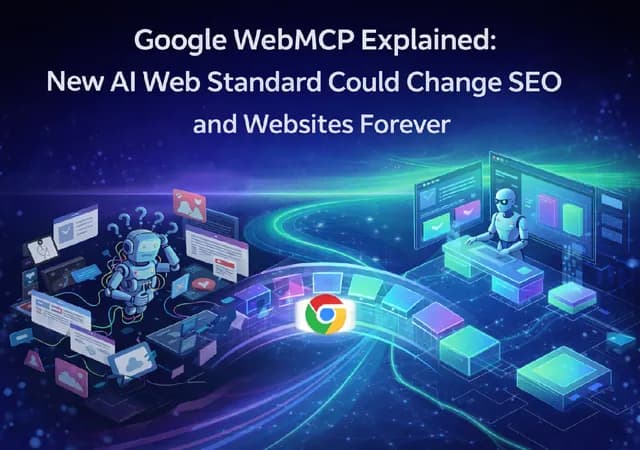
There is something big happening in the online arena and most of the website owners are unaware of this.
Google WebMCP was quietly launched by Google on February 10, 2026. The future of the web standard is likely to entirely change the interaction between websites and AI tools, such as ChatGPT, Claude, and Gemini.
This changes the mechanism of working of the internet at its fundamental stage. If you own a website, not paying attention to it could hurt your visibility, traffic, aand even your business in the immediate future.
What Google WebMCP actually is
Right now, AI agents behave like confused users when they visit websites. They rely on screenshots, messy HTML, and guesswork just to click a button or fill a form.
Google WebMCP fixes that problem.
It enables websites to communicate directly to AI agents by telling them:
- What actions are available
- How to perform those actions
- What data is needed
It is like giving your website a voice. Your site clearly says, "Here is how to book, search or submit," so AI does not need to guess.
In simple terms: Websites stop being passive pages and become interactive tools for AI.
Why this new standard even exists
The rise of AI assistants created a serious problem.
Today, users are asking AI to do tasks including:
- Book flights
- Order products
- Submit support tickets
- Compare prices.
But AI struggles because websites were never designed for machines, only for humans.
That’s where Google WebMCP comes in. It removes guesswork and makes interactions faster, cheaper, and more reliable.
Interestingly, the idea didn’t start at Google. It was first explored by developer Alex Nahas inside Amazon systems. Later, Google and Microsoft turned it into a broader web standard under W3C.
How it works behind the scenes
Google WebMCP introduces two simple ways for websites to interact with AI agents:
1. Declarative API (simple method)
Developers add small attributes to existing HTML forms. For example, a booking form can tell AI exactly what it does.
2. Imperative API (advanced method)
Developers reveal JavaScript functions such as:
- searchProducts()
- bookAppointment()
- addToCart()
These functions can be directly called by AI agents without guesses or blindly clicking.
And the most important part is here: Everything happens in the browser. No additional servers or complex setup.
Why this matters for SEO
This is where things get serious.Search behavior is changing fast. People are no longer just typing queries, they are giving commands to AI.
Instead of: “Best hotels in Jaipur”
Users now say: “Book me a hotel in Jaipur for Friday under ₹5,000”
And guess what?
AI doesn’t show links, it just gets things done.
So here’s the reality:
- If your website supports AI interaction, it gets used.
- If not, it gets ignored and replaced by a competitor.
SEO is no longer just about ranking. It’s about being usable by AI agents.
Experts are already calling this the biggest SEO shift since structured data, and that doesn’t sound exaggerated.
The security side and real concerns
Let’s address the obvious fear: Can AI misuse this?
Surprisingly, Google WebMCP is actually safer than current AI browsing methods.
Instead of giving AI full access to your page, it only allows pre-approved actions, controlled functions and user-confirmed sensitive tasks.
For example, if an AI tries to make a payment, the browser will ask for permission first.
Yes, risks like prompt injection still exist. But compared to current automation, this is a big step forward.
The three types of AI tools websites can offer
Most WebMCP features fall into three categories:
- Read tools: Used to fetch data like product details or availability.
- Navigation tools: Help AI understand the structure of your website.
- Write tools: Allow actions like form submission, booking, or checkout (with user approval).
Even a basic website can become AI-ready with these tools.
When will it be available widely?
Right now, Google WebMCP is in early preview inside Chrome Canary (version 146).
- Edge support is expected soon
- Firefox and Safari are still in discussion
- Wider rollout likely by mid-to-late 2026
So yes, it’s early, but this is exactly when smart businesses prepare.
This is bigger than most people realize
Honestly, this feels like one of those moments we’ll look back on, like when mobile-first websites became necessary.
At first, people ignored it. Then suddenly, it became everything.
Google WebMCP is heading in the same direction.
If your website cannot “talk” to AI, it will slowly become invisible in an AI-driven internet.
That’s not hype. That’s where things are clearly going.
What you should do right now
You don’t need to panic, but you do need to prepare.
Start by cleaning and structuring your website forms, identifying key actions like booking, search and contact, talking to your developer about AI-readiness, and deciding what actions you want AI to perform, because early adopters always win in tech shifts like this.
Google WebMCP is not just a technical upgrade, it’s the foundation of an AI-first web. The sooner you adapt, the better your chances of staying visible in the future internet.